


Let's Talk Turtles

Spring is coming, and as our ground, ponds, and lakes start to thaw, turtles are going to start rising up from the depths like creatures of myth, eager to feel the sun’s warmth once again.
I like turtles. Chances are, you do too. Out of all the reptiles, they’re the ones that the general public seems to consistently adore, and for that reason many of these cute little guys end up taken from the wild and kept as pets.
But turtles have a lot of needs that most people aren’t aware of and don’t think about. For one, they are cold-blooded ectotherms, meaning they rely on the temperature around them to heat their bodies and digest food. If it’s too cold and food is still in their systems, it ends up rotting and causing a lethal condition called sepsis. So, turtles need heated water and warm basking locations to live.
While all reptiles benefit from UV light - the high-energy wavelength just beyond our visual spectrum - turtles absolutely need it. Without it, they cannot absorb calcium and begin to develop lethal bone and shell diseases. Outdoors, they get plenty of UV-B radiation from the sun. But kept indoors, they need special light bulbs that emit UV-B. These bulbs are expensive and stop emitting UV-B over time, meaning they need to be regularly replaced.

They also poop. A lot. Meaning they need powerful filtration to keep their water clean and prevent bacterial and fungal infections. They also need a LOT of space. That cute little hatchling you found will grow to need a minimum 100+ gallon tank and live for 30-50+ years. Not many people are prepared for an expensive pet that will live with them until past retirement age.
So to sum up - you need to have heated, well-filtered water in a large tank that includes basking areas, heat bulbs, UV-B lights, and feed them a specially balanced pellet diet that meets their nutritional needs. All of those lights, heat, food, and water are expensive. And turtles live for decades.
That’s how we ended up with our common snapping turtle, Mitch, and our little softshell turtle, Pancake. Someone removed these animals from the wild when they were cute and small, found that they quickly outgrew a 20-gallon aquarium, and needed someone else to take them. Having been kept in captivity for so long, they cannot be released back into the wild. To keep native wildlife in Michigan, you need to have the proper permits and continually renew them every few years.

Turtles in Trouble
Turtles are slow to grow to breeding age, and most young turtles will never make it. That means even a single turtle removed from the wild - whether by the pet trade, roadkill, or hunting - affects the population for decades to come.
When I was growing up, we visited local lakes and creeks every summer and deliberately fished for snapping turtles. We were told that snapping turtles kill off all the fish in a lake. We were incentivized by a friend of the family who paid handsomely for turtle meat. And it didn’t help that out of all the turtle species, snapping turtles looked like their reputation - primitive, cantankerous, and smelly - and therefore very killable. Now, I empathize with Aldo Leopold and his regrets about helping eradicate wolves during his youth - those summers spent on the lake are one of my biggest personal regrets.
Fishing for turtles is still permitted in Michigan and many other states, with applicable seasons, catch limits, and minimum sizes. We’re all about sustainable harvest of wildlife, especially of species that humans have sustainably hunted and helped control for tens of thousands of years in North America. But due to their slow growth and reproduction, there is no sustainable harvest for turtles. Minimum catch sizes force fishermen to target the few, breeding-age turtles, causing maximum damage to their populations. Add in the pet trade, over-predation, and road mortality, and turtles aren’t doing so well.

Today
It’s a pleasure to see a newly awakened snapping turtle, dirt piled up on his back like the World Turtle of Asian myth, or Turtle Island of the Anishinaabe. It’s heartbreaking to see crushed snapping turtles littering the sides of the road, many of them so far in the margins that vehicles must have swerved to hit them.
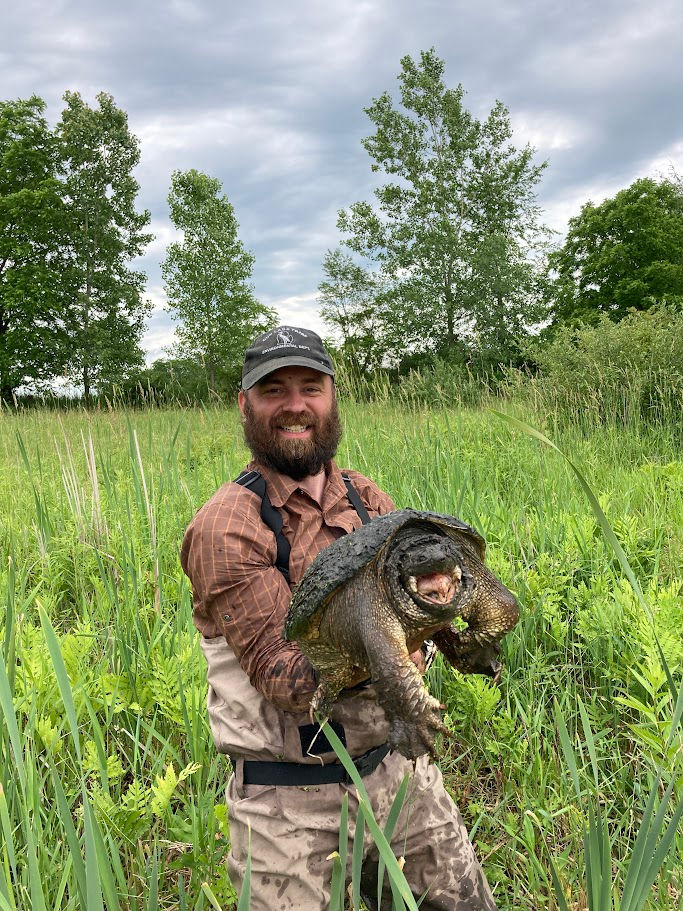
Snapping turtles aren’t monsters. They have undersized shells that allow them better movement at the cost of being more exposed to predators, hence they’ve evolved a feisty behavior to ward away attackers. This fear-based behavior disappears when the animals are no longer afraid, and turtles like our Mitch who are habituated to people even seem to enjoy human contact.
They also don’t eradicate all the fish in a lake. Rare is the snapping turtle who can catch a healthy fish - they mostly act as scavengers on dead or dying fish, helping keep our waters clean. And no - they are not capable of taking off your finger with a bite. Their bites, while painful, are weaker than any human’s.
So why write about turtles now, in February? Well, they’re already beginning to awaken, especially with these warm days, and we’ll soon see them out and about. Plus, you know, turtles. They’re awesome. Why shouldn’t we write about them?
For more information, visit https://parcplace.org/species/turtles/


